Back to insights
Materials & Fabrication
How Panel Specifications Align with Details During Design Development
Published
This article explains how panel size, thickness and detail solutions should be coordinated during the design-development stage to reduce later adjustments, fabrication errors and installation deviations.
Key points to confirm during design development
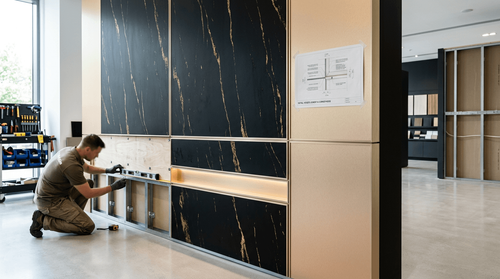
Once a project enters the design-development stage, panel size, thickness, edge treatment and substrate conditions should no longer be discussed separately. They need to be coordinated together with detail solutions. This is especially important at wall corners, light slots, cabinet fronts, shaped surfaces and joint areas. If only the material direction is confirmed early while size and detail conditions remain unclear, later adjustments in fabrication and installation become much more likely.
- 1. Panel sizing and layout logic: confirm whether single-panel size, joint pattern and layout strategy work with the actual wall and structure conditions.
- 2. Thickness and substrate compatibility: make sure the panel thickness works properly with framing, backing boards, light slots and trim systems.
- 3. Joints and corners: determine joint width, corner solutions and edge treatment early to avoid temporary changes later.
- 4. Shaped and special areas: curved surfaces, illuminated interfaces, cabinet fronts and other irregular areas should be checked for fabrication feasibility during design development.
- 5. Linking samples with details: sample confirmation should be reviewed together with detail sketches and application positions, not only as a surface-finish decision.
The earlier panel size, detail solutions and installation logic are confirmed together, the more stable the later fabrication, delivery and on-site execution process will be.