Materials & Fabrication
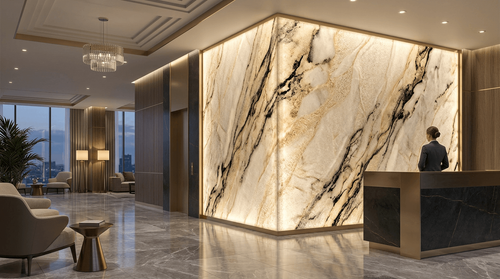
What Materials Work Best for Backlit Hotel Lobby Walls?
Published
This article reviews common requirements for backlit walls in hotel lobbies and compares several suitable material directions from the perspectives of material appearance, lighting coordination, construction conditions and project delivery.
Hotel lobbies usually serve as reception, identity and display spaces at the same time. For this reason, selecting materials for a backlit wall involves more than simply choosing a light-transmitting panel. Spatial character, lighting performance, detailing, maintenance and execution rhythm all need to be considered together.
I. Common Requirements for Hotel Lobby Backlit Walls
In hotel projects, a lobby backlit wall often needs to deliver visual focus, brand identity, lighting atmosphere and spatial layering at the same time. The material should provide decorative value while also working reliably with the lighting system, substrate structure and edge detailing, instead of only looking good in renderings.
II. Material Directions Worth Comparing
Materials commonly considered for backlit walls include translucent resin panels, acrylic, decorative glass and certain composite decorative materials. Translucent resin panels are more suitable for expressing texture, layering and soft light, making them especially valuable in hospitality spaces requiring atmosphere and custom visual effect. Acrylic tends to be cleaner and brighter, while glass emphasises transparency and structure but requires greater attention to safety and installation.
III. Lighting and Detailing Must Be Coordinated
The final effect of a backlit wall depends not only on the face material, but also on how the lighting and detailing are designed. Backlight uniformity, colour temperature, maintenance access, heat dissipation, joint treatment and edge finishing should all be confirmed during design development. Temporary adjustments later often lead to compromised effect and schedule pressure.
IV. How to Make a More Reliable Material Decision
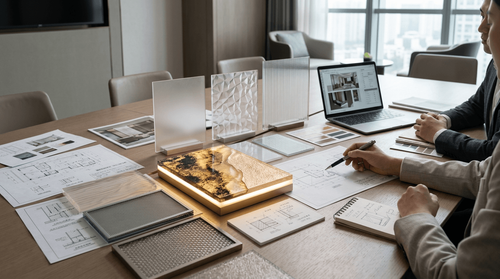
For important spaces such as hotel lobbies, materials should not be chosen based only on reference images or sample books. It is more reliable to arrange sample comparison early in the project. Samples help evaluate texture, translucency, lighting performance, colour deviation and compatibility with the actual environment, reducing the risk of repeated adjustments later.
Overall, choosing materials for a hotel lobby backlit wall should be based on space positioning, lighting requirements, construction conditions and maintenance needs. The more important the display area is, the more necessary it is to confirm materials, samples and detailing in the early stage for stable project delivery.