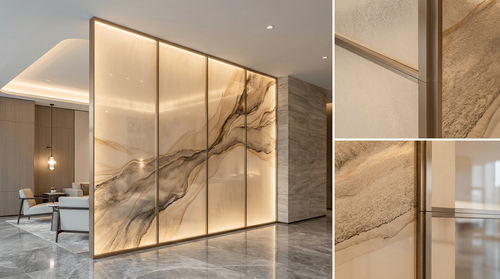
Materials & Fabrication
Can Translucent Resin Panels Be Customized?
Published
This article outlines common customization directions for translucent resin panels in terms of size, colour, texture, light effect and fabrication, helping project teams confirm requirements more efficiently during selection and sampling.

In actual projects, translucent resin panels are rarely used as fully standardised products. Instead, they are often adjusted according to space dimensions, lighting methods, decorative goals and installation conditions. The more a project depends on visual effect, the more important it is to confirm size, colour, texture and fabrication direction in the early stage.
I. Size and Panel Layout Customization
In project applications, translucent resin panels often need to be adapted to walls, light boxes, partitions, columns or decorative structures. In addition to the size of each individual panel, project teams should also consider joint layout, installation structure, edge detailing and transportation conditions. For large surfaces or irregular areas, size confirmation becomes especially important early on.
II. Colour and Texture Direction
Colour and texture are usually the most visible parts of customization. Different projects may prefer warm tones, cool modern tones, natural textures or more decorative visual effects. Material selection should not rely only on static samples; the actual appearance under lighting should also be evaluated to avoid differences between expectation and final result.
III. Light Effect and Lighting Coordination
The final appearance of a translucent panel depends on the light source behind it, the level of translucency, panel thickness and surface texture. If the project has clear requirements for illumination uniformity, lighting hierarchy or atmosphere colour temperature, lighting tests should be included in the sample stage instead of confirming only the material itself.
IV. Key Points in Fabrication and Sampling
Before production begins, it is advisable to confirm material direction, size logic and lighting effect through samples. In addition to visual performance, perforation, slotting, edge treatment, joining methods and installation conditions should also be considered. Many later-stage issues can actually be discovered and solved during the sample stage.
Overall, customization of translucent resin panels is not simply a matter of adjusting size. It involves coordination between material, lighting, structure and decorative effect. The more thoroughly the requirements are confirmed in the early stage, the more stable and efficient the later implementation will be.